
by Ashley Murray, North Dakota Monitor
September 15, 2026
WASHINGTON — FBI Director Kash Patel sidestepped questions about FBI agents at polling places in the midterm elections at a U.S. Senate hearing Tuesday that also featured a tense... more
The number of Iowans exhibiting one or more "problem gambling" behaviors has increased to 16 percent, 369,000 people, according to a recently released survey by the Iowa Department of Public Health.
The survey – "Gambling Attitudes and Behaviors" conducted in 2013 by the University of Northern Iowa Center for Social and Behavioral Research – also found one in five adult Iowans (18 percent) had been "negatively affected by gambling behavior of a family member, friend, or someone else they know."
Nearly 30 percent of Iowans reported "knowing a person with gambling problems," and 7 percent of state residents have experienced someone in their family having a gambling problem when they were growing up, according to the study.
More than half of state residents – 53 percent – now feel the harm of gambling on society outweigh the benefits. Another 30 percent say the benefits of gambling are equal to the harm it causes. That's despite the sizeable contribution of more than $200 million to the state from gambling each year, along with the requirement the casinos pay a percent of revenue for distribution to non-profit charitable organization each year.
While the study says the increase in people "at risk" of becoming "problem gamblers" was not "statistically significant" when compared to its 2011 study findings, the new report estimates the number of people "at risk" of becoming problems gamblers in the state was 369,004 in 2013, compared with 303,315 in 2011. Similarly, the number of gamblers with the most severe problem or "pathological" addiction more than tripled from 13,036 in 2011 to more than 46,000 in 2013. Because of the sample size and possible deviation in the results, the higher number of problem gamblers found in the most recent survey also was not deemed statistically significant.
To determine the prevalence of problem gambling, the study used a methodology which asks 10 questions. If the individual meets four of more of the 10 behaviors, he or she is classified as having a "persistent and recurrent problematic gambling behavior leading to clinically significant impairment or distress." If the individual meets one or two of the behaviors, the person is classified as being "at risk" of becoming a problem gambler.
The questions are:
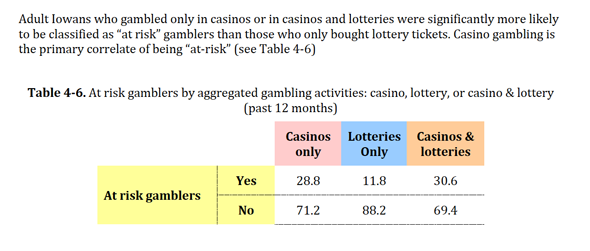
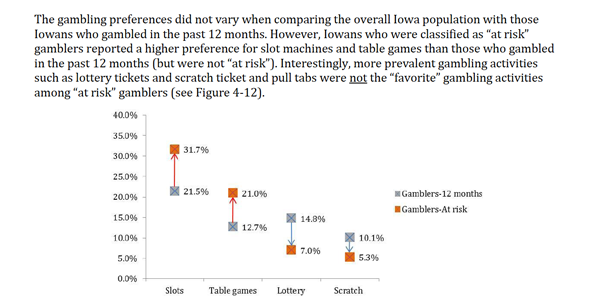
Not surprisingly, Iowans gambling only in casinos or in casinos and lotteries were much more likely to be classified as "at risk" gamblers than those only playing the lottery. "Casino gambling is the primary correlate of being 'at risk,'" according to the health department study.
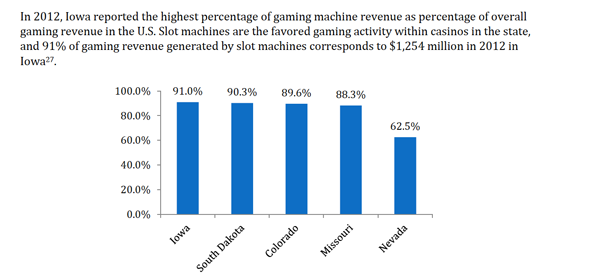
And, slot machines are the cash cow for casinos and the state, according to the report. "In 2012, Iowa reported the highest percentage of gaming machine revenue as percentage of overall gaming revenue in the United States," the report says. "Slot machines are the favored gaming activity within casinos in the state, and 91 percent of gaming revenue generated by slot machines corresponds to $1.25 billion in 2012 in Iowa."
CLICK HERE to download a copy of the full Iowa Department of Public Health Survey.

